Showing posts with label Portiere. Show all posts

Wednesday, October 7, 2015

Period Book: Distinctive Homes of Moderate Cost (1910)

I found another chapter on portiéres (room door curtains), and, as usual, I am sharing it. Who knows if anyone is interested in this besides me, but at least it makes it convenient for me to access the information. LOL  This is a word-for-word transcription of the chapter.

The book is called Distinctive Homes of Moderate Cost and was written by Henry H. Saylor, ed. and published in 1910. If you'd like to see the original text, you can download it here at Internet Archive.

PORTIERÈS AND WINDOW DRAPERIES

SUGGESTIONS FOR HANGINGS MADE FROM INEXPENSIVE MATERIALS FINISHED WITH SIMPLE DESIGNS IN APPLIQUÉ AND EMBROIDERY

There seems to be a sad lack of originality in the hangings one sees today. It is nearly always the same old velour or the same old rep, guiltless of any relieving color in the way of an edging or an appliqué design. Why not get some distinction into these important elements of home decoration?

After all, the portières in a home are just as important factors contributing to the success or failure of the whole as are the wall covering or rugs. Because they occupy less area than the things we put upon the walls or floors, they are only too frequently passed over without their due of consideration. Their importance and value in carrying out a comprehensive scheme of decoration in color and design is something that may well be reckoned with.

It should be understood at the outset that in the short space allotted to this section it is quite impossible to cover the whole subject of portières. It goes without saying that the designs illustrated here would be utterly incongruous in an Empire drawing-room, for example. In rooms, also, in which other French or Georgian period styles have been carried out in the architectural details and in the furniture, the hangings should, as a matter of course, be along the same lines. There are many beautiful fabrics from which to choose portières for rooms furnished in period styles—and at prices to suit everyone; velours, linen, upholsterers’ velvets, self-crinkled tapestries, brocades, corded silks, goat's hair, Armures, figured tapestries—each of which may be found the one suitable material for a certain purpose.

It is for the everyday American living-room, den, library, or hall, however, that the designs here shown  would solve the problem of hangings—rooms where no period style has been permitted to assume its jealous reign, but where the furnishings are of the simple, unassuming character that marks modern American work of the best type. In such a room the note of individuality and distinction that any of these designs strike will be a welcome and unobstrusive one.

Saturday, October 3, 2015

Period Book: Art and Economy in Home Decoration (1908)

One of the things I like to cover in my blog are topics that are only rarely covered elsewhere (perhaps for good reason LOL). In my recent book downloading efforts, I found one with a chapter on portiéres (room door curtains), so I thought I would do a blog post to convey the information they provided. This is a word-for-word transcription of the chapter.

The book is called Art and Economy in Home Decoration and was written by Mabel Tuke Priestman and published in 1908. If you'd like to see the original text, you can download it here at Internet Archive.

WHAT TO USE FOR PORTIÈRES AND CURTAINS 
IN THE COUNTRY HOUSE

IN many country homes curtains that suggest the modern trend of thought would be out of harmony with their surroundings. If a parlor is furnished in Empire style, what could be more incongruous than hangings of coarse canvas, ornamented with art-nouveau designs? The curtains must be in harmony in tone and design with the Empire period, and would need to be made of rich-looking materials, overtopped with the fitted valance ornamented with Empire designs.

Georgian and French styles must be treated with the same restraint, if the rooms are to be faithfully carried out in any one period, and the curtains must conform to the general style of the room.

In going into houses of well-to-do people, it is surprising to find that draperies that have been made by reliable firms have lost their shape and sag. This should not happen, and would not if sufficient care had been taken when the curtains were made. When they are laid out on the cutting table the interlining must be sewed or basted to the material, so that when in place the curtains keep their shape. Sometimes the bastings are caught only here and there, and after a while they give way: the result is a sagging, lumpy-looking curtain. If the curtains had been made properly in the beginning this trouble would have been avoided.

The draperies of a room should always harmonize with the walls, but should be stronger and richer in tone. Hanging in soft, straight folds, they soften the hard lines and add much to the beauty and dignity of a well-planned room. In providing portières for a double door, the portière can be made by lining or sewing two separate materials so as to form one curtain. The curtain itself will look well, but either one side or the other of the opening will show a blank space of woodwork; also when the sliding doors are closed, one room will be without its portières.

The most usual way is to make the portières to suit each room, the lining of one matching the front of the opposite portière. It is best to use sateen as a lining, as this is made in a wide range of colors. Wherever possible, the lining should match the curtain, but if the heavy curtains at a window are hung wide enough to come in front of the cream or white curtain, and will be seen through the sheer curtains from the outside, then they must be lined with cream. To my mind curtains lined with the same shade are much more attractive than those lined with white or cream, but they should not be more than twenty-four inches wide when pleated up, and not be brought forward to go in front of the window.

An abomination constantly seen is a pair of heavy curtains meeting in the middle of a window and then held tightly back by a cord or band. They give a feeling of uneasiness to those who appreciate the fitness of things, and are in themselves a contradiction. Why hang them forward if you want them back? The same fault may often be seen in sash curtains. They are hung on a rod at the top and bottom of a window, and then a foolish white band or cord holds them back in the middle.

Monday, June 24, 2013

Period Book: Successful Houses (1902)

On my continuing quest to find good early 1900s sources for furnishing middle class bungalows, I ran across Successful Houses by Oliver Coleman. This is another opinionated, and vastly entertaining book dating from 1902. It can be downloaded for free from Internet Archive here. And while it does mostly seem to give at least equal treatment to painted Victorian-type decor, it does still have some fun and useful bits for us craftsman style enthusiasts.

Once I read the beginning of the Introduction, I knew I wanted to continue reading:

"There are comparatively few people at one time or another do not have to face the problem of household furniture and decoration, and who do not as such times experience a sensation of comparative helplessness. To assist them there have been published two classes of books only, one in which the information is of the most shocking character, utterly devoid of taste, judgment or good sense; the other in which the laws are of a learned and technical character, but difficult by private persons in their own homes. Many of the latter class of publications are great authority, and could their intent be thoroughly absorbed would lead to radical improvements in the popular idea of household decoration; but unfortunately, besides the ponderous text, the illustrations are usually chosen from views of palaces and other great houses, and convey no suggestions to the discouraged housewife with a few hundred dollars to expend at most." (emphasis added)

This book is a little difficult to pull the relevant parts down into a reasonable size blog post. There are literally so many hilarious comments about their current practices that I'm tempted to over-quote the book because the humor would be lost in a summary, but, I obviously cannot do that. I can include some of my favorite quotes and recommend this book to those of you who get a kick out of decorating books like this. It's really too bad modern books aren't written in this style anymore. They're all written so as not to offend anyone so they seem so bland and uninteresting.

For instance, when talking about art, he says, "The need of [pictures] is never half as great as most of us suppose and here, they never should be hung simply to fill walls, regardless of their worth. What weak, insipid things, what base and ill-made copies, what plate-worn etchings and process colored plates are here often flaunted in the face of every stranger who may enter, and on the very threshold cry out to him how little taste and judgment there is within the house!"

And later he adds: "ornaments for the sake of ornament should find no place. The vases should be of a character to hold flowers, the candlesticks to give light and the fireplace to hold a fire." You should design and furnish your drawing room to put guests at ease, not to "astonish with a lavish display."

His book seemed to have the opinion that paint was the poor man's solution to decorating, "Those who have but little wealth should as a last resort turn . . . to paint." "It is painted furniture to which I would now refer as the third class of possibilities. One may often by diligent search among the marts of commerce discover chairs and tables and even sideboards of simple, good design. These pieces when so found are usually lacquered over with some species of yellow shellac and varnish which makes them unfit for any ornamental purpose. But paint will cover all."

Then there follow quite a few chapters on general decorating schemes. Mr. Coleman gives quite a lot of advice about finishing in colors, papers, and fabrics; advice for finishing the cheaper woods; artificial illumination and finishing with small ornaments. There are really too many suggestions to be copied here; if you're interested, go download the book and read it. But here I share a few of my favorite parts:

". . . in the treatment of walls and ceilings lies much of the success or failure in the outcome of a room. If it be warm and bright, the room will surely be so also; while if, upon the other hand, the coloring be in neutral tints, afraid to say its say, the room will have a dingy, faded look, which nothing in the furniture can recompense. . . I would have color in every room, bright, strong, cheering color, that should make sunshine on the darkest day, warmth on the coldest, and cheer on the saddest."

"The excellence of wooden walls and ceilings cannot be overstate. They have a solidity and dignity which otherwise came with the use of stone only, yet have much more of the qualities of home. Finished in natural colors, if the quality allows, age and the passing years can only add new beauties and bring out new charms."

"The bric-à-brac must be subservient to the general decorative scheme of the house, and must not fasten itself in every corner and on every wall until the house shall look like a curiosity shop or an auction room."

There is a chapter on using portieres, which I quoted in its entirety in  this blog post.
Portiere
And there is a chapter on using soft woods, which were a cheaper option for most folks. (Our house is finished in a soft wood, douglas fir.) "The simplest way to finish stained wood is to cover the stain with one or two coats of raw linseed oil; while the best way is to give it three coats of thin-spirit white shellac, and rub with pumice-stone and oil to give it a dead, even finish."

I think many of his ideas are still valid today, though obviously only one opinion among many different opinions of his time.
Living room
Mahogany dining room
Library - I find it interesting that none of the chairs match

Monday, August 6, 2012

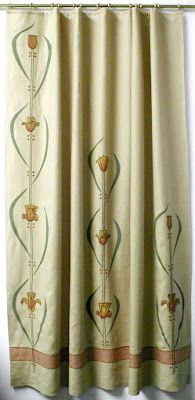
Tulip Portiere

I really cannot stand the French doors in our living room and dining room. They don't stay closed and they don't work with our rugs without chopping quite a bit off the bottom of the doors. They also take up a lot of wall space, which is at quite a premium in this room. These doors probably made a lot more sense when the fireplace was used to supplement the heating on the main floor.

 
So, I've been thinking about making portiere curtains to hang in those doorways so we can take down the French doors and reclaim the limited wall space.

(We would, of course, retain the doors and stow them in the attic for the next owner. Though, we discovered during the remodel the French doors are not original to our house—the house was originally built with pocket doors.)

Anyway, I ran across this portiere design at Textile Studio's web album and I'm in love. I really wish I could afford to buy a set, but perhaps I can make them. I'd actually need to make four of these panels to span both doorways. I guess I found another project to add to my queue.

Update many hours later: When I was trying to research how to actually make a portiere (to answer questions like whether it was lined, or suspended by rings), I went and dug through a number of period texts. I share the best of them below.

Tuesday, March 8, 2011

Embellished Door Curtains called Portieres


Sharon believes these curtains were used for doorways and were called portières. She's collected quite a number of examples from all the issues of "The Craftsman" magazine she scanned for photos.


Craftsman Magazine, Aug 1903

Craftsman Magazine, Aug 1903

Craftsman Magazine, Aug 1903

Craftsman Magazine, Aug 1903

Craftsman Magazine, Nov 1903

Craftsman Magazine, Dec 1903
Craftsman Magazine, Mar 1904

Craftsman Magazine, Mar 1904

Craftsman Magazine, Jun 1904

Craftsman Magazine, Jun 1904

Craftsman Magazine, Ju 1904
Craftsman Magazine, Aug 1904

Craftsman Magazine, Aug 1904

Craftsman Magazine, Dec 1904

Craftsman Magazine, Dec 1904
Craftsman Magazine, Feb 1908

Craftsman Magazine, Apr 1904

Craftsman Magazine, Apr 1904

Craftsman Magazine, May 1905

Craftsman Magazine, May 1905

When I was trying to research how to actually make a portiere (to answer questions like whether it was lined, or suspended by rings), I went and dug through a number of period texts. I share the best of them below.